3 min read
Someone emailed me about a page I didn't have
I set up me@danielhadaway.dev with this site and it sat empty. The first email to land in it was a stranger in Texas asking if I'd build a page I'd never heard of. I built it that evening.

I set up me@danielhadaway.dev when I launched this site, and then it sat there doing nothing. The first email to land in it wasn't a receipt or a password reset. It was Nick Gray, in Austin, Texas, asking if I'd consider building a page I'd never heard of.
Hi! I saw your /now page from the index that Derek Sivers made. Would you ever consider making a /friends page where you link to your online friends?
Then the part I liked most, right at the bottom:
p.s. No reply needed if you're busy or not interested. I will not email you again.
That is how you write a cold email. No hook, no follow-up sequence, no “just circling back”. Ask once, mean it, leave.
So I read into it. A /friends page is the old blogroll brought back: you point at people you like instead of at yourself. slashfriends.org keeps the directory, the same way nownownow.com keeps the /now one. Which is the neat bit, because my /now page is what put me on Derek Sivers' index, and that index is how Nick found me. One small web convention handed me straight to another.
I built mine the same evening and replied the next morning.
His reply came back in capital letters. He'd already seen the site featured on slashfriends.org, said it made his morning, and offered to link back from a few places on his own domain. And then the bit I've enjoyed more than I probably should: he'd found the trophy that pops up when you reach the bottom of a page, and said that as a terminally online person he'd never seen that before. Ten years of shipping production software, and the thing that lands is a hidden trophy. That's the feedback I'll take every time, though. Plenty of people will tell you a site looks nice. Someone telling you they found the daft thing you built purely for fun means they were actually paying attention.
What I've taken from it is that /now and /friends both do something most of the web has stopped bothering with. Nearly every page is selling you something. These two point away from the author entirely. /now says what I'm doing this month, /friends says who I'm reading. Nothing to buy on either.
So go and read a few /friends pages. Start with Nick's, then mine. They're the quickest way to work out who someone actually pays attention to, and they're a good way into corners of the web you'd never search for. And if you like someone's site, email them. Apparently that still works.
Enjoyed this one?
Hit the heart so I know to write more like it.
Keep reading
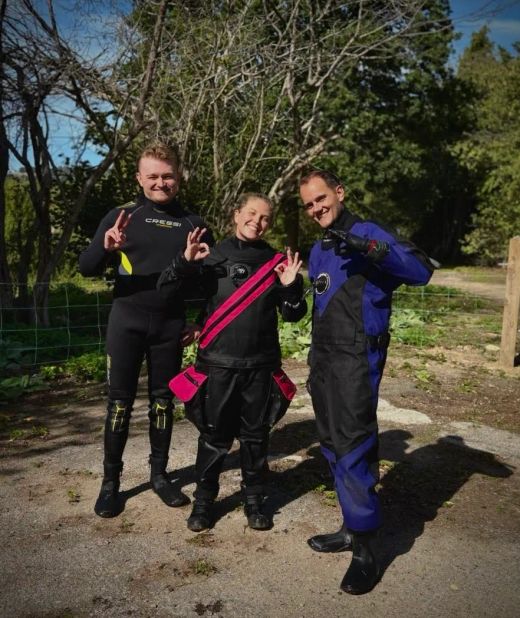
Three days, two lakes and one leaky dry suit
I've wanted to learn to dive since I was a teenager. Three days, one pool, two lakes and an online exam later, I'm a BSAC Ocean Diver. I also lost a mask, discovered a dry suit is not always dry, and noticed my weight belt was loose at 18 metres.

£1,330 a year off three clients' bills
I kept telling people I save clients money without ever putting a number on it. So I built a running total that works itself out daily, and made it show where every line came from.

38 things I keep forgetting
No two sites I build get built the same way. Some start in Lovable, some start from a repo I pulled down, some start from nothing. The list is the only part that stays the same.